OUR AIM IS TO SHED LIGHT ON THE MOST PRESSING GLOBAL ECONOMIC CHALLENGES TO IMPROVE INTERNATIONAL ECONOMIC POLICY
Updates
“Understanding Geoeconomics in a Volatile World”, an article by Christopher Clayton, Matteo Maggiori, and Jesse Schreger, came out in the June 2026 edition of the IMF F&D magazine. Read the article here.
Our paper “Putting Economics Back Into Geoeconomics” by Christopher Clayton, Matteo Maggiori, and Jesse Schreger, has been published in the NBER Macroeconomics Annual 2025, volume 40
More information here: https://www.nber.org/books-and-chapters/nber-macroeconomics-annual-2025-volume-40/putting-economics-back-geoeconomics
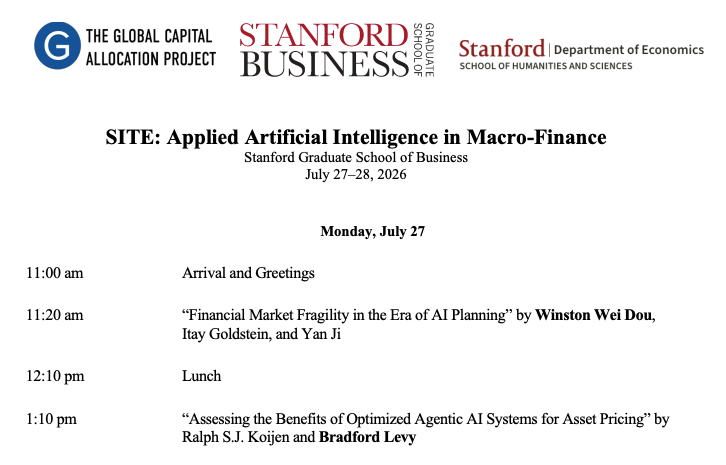
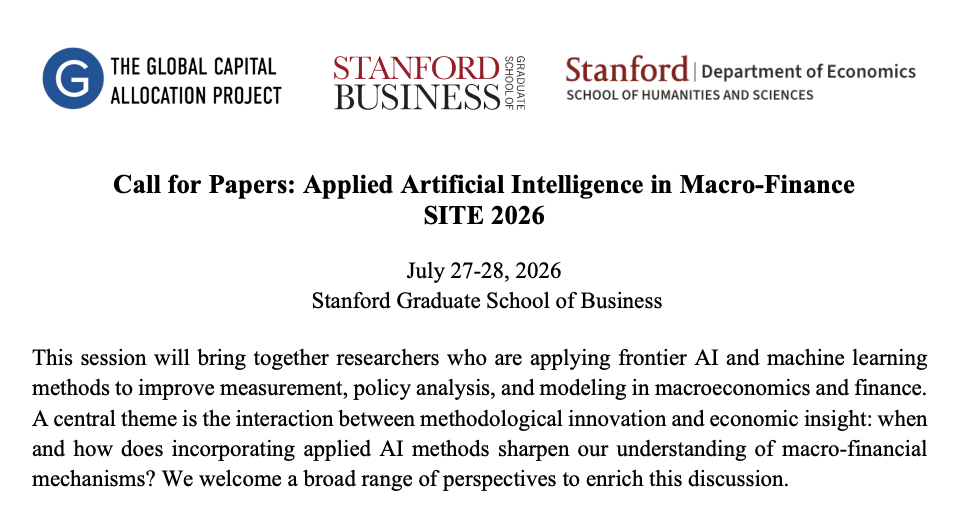
This session will bring together researchers who are applying frontier AI and machine learning methods to improve measurement, policy analysis, and modeling in macroeconomics and finance. A central theme is the interaction between methodological innovation and economic insight: when and how does incorporating applied AI methods sharpen our understanding of macro-financial mechanisms? We welcome a broad range of perspectives to enrich this discussion.
The conference will be organized by Christopher Clayton (Yale University) and Antonio Coppola (Stanford University).
The conference will take place on July 27-28, 2026, at Stanford GSB. The call for papers is available here.
The agenda for the the RFS-GCAP-BGS Conference is now available. It can be viewed here or on the event website.
Our paper “A Framework for Geoeconomics” by Christopher Clayton, Matteo Maggiori, and Jesse Schreger has been published in the Econometrica, Volume 94, 2026.
The agenda for the the JIE-GCAP-BGS Conference is now available. It can be viewed here or on the event website.
In the News
“One of the most pragmatic pieces in the IMF issue was written by Christopher Clayton, Matteo Maggiori, and Jesse Schreger. Their central argument is simple: geoeconomic power comes from controlling "choke points". If countries depend too much on one country, for example, then it is easy for that country to leverage its position. That's called a hegemon. In the post-war period, the US assumed this status. But they also caution that overusing this power is self-defeating. It drives other nations to seek alternatives.”
“In a paper in the IMF’s F&D Magazine, Christopher Clayton, Matteo Maggiori and Jesse Schreger remind us that the US has used its geoeconomic power to impose comprehensive financial sanctions on Iran and Russia. But they also make the important point that overuse of this power is self-defeating because it drives nations to seek alternatives.”
“[Matteo Maggiori] `It’s clear to everybody that for the next 20 years, we’re going to live in a world where large countries like the US and China exert a lot of influence abroad. Such issues are already shaping the world. To me as an economist, this is an enormously important field.’”
“According to a team of academics including Jesse Schreger of Columbia University, by 2025 the share of global companies reporting they were affected by export controls was more than triple the average over the 2010s. The biggest contributors to that were US export restrictions on China.”
”Part of a financial regulator’s role is considering policy interventions to prevent or mitigate financial crises. Rather than predicting crises, [Antonio] Coppola's current work is focused on ‘if this big wave of stress comes along, where are the problems going to be? Who exactly is going to get in trouble?’”
”Jesse Schreger of Columbia University shared findings that after being hit by an export control, Chinese companies were twice as likely as American ones to invest in research and development. In this game, the scores could change.”